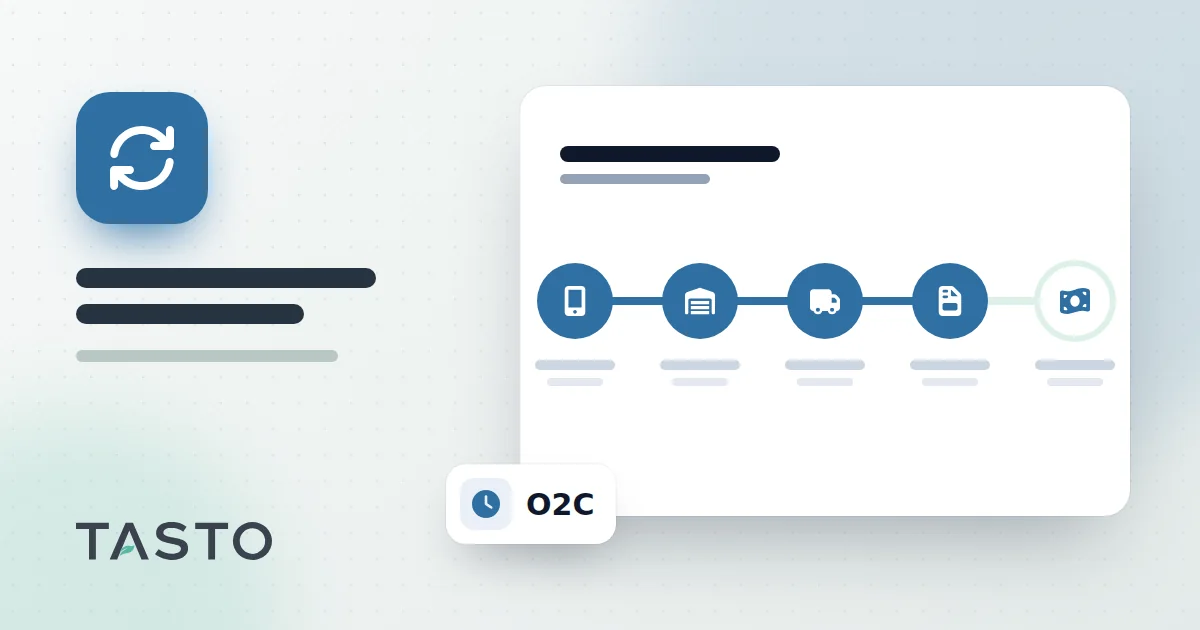
An order starts with a rep or on the customer portal and ends when its value reaches the company's account. In between it passes through sales, credit, the warehouse, the fleet and finance. This journey is the order-to-cash cycle, and its efficiency shapes a distributor's cash position more than its sales volume.
The stages of the cycle
- 1
Order entry
By a rep, on the customer portal or by customer service, at the client's own prices and offers.
- 2
Credit check
Order value compared with available credit after open balances and post-dated checks.
- 3
Reserve and pick
Quantities reserved in the right warehouse and picked by barcode from the right batch.
- 4
Delivery
Loading, verified arrival at the client and a signed receipt.
- 5
E-invoice
The invoice is issued, signed and sent to the Tax Authority at delivery.
- 6
Collection
Cash, check or transfer, matched to the right invoice.
- 7
Posting and reports
Every move becomes a journal entry and the margin reaches management reports.
Where do money and time leak?
| Leak | What happens | Effect |
|---|---|---|
| Re-typed orders | Orders arrive as messages and are keyed again at the office | Quantity and price errors, slower picking |
| Late credit checks | Goods are delivered before anyone sees the client is over limit | Bad debt |
| Stock shortages | An order is accepted, then the item turns out unavailable | Partial delivery and an unhappy client |
| Late invoices | The invoice is issued days after delivery | Payment terms start later |
| Unmatched collections | Money collected with no link to an invoice | Inaccurate receivable aging |
Indicators that measure the cycle's health
For more indicators and how to compute them, read the 15 KPIs that matter for distributors.
How one system shortens the cycle
Separate tools
- Orders in a file or a message
- Stock in another program
- Invoices uploaded by hand
- Collections matched at month-end
One system
- The order is entered once and flows through every team
- Reservation from live stock
- The invoice is issued at delivery
- Collections matched to invoices instantly
An order written once and passed through every department removes many errors that never appear in any report.
See the whole cycle on a single order on the TASTO home page, where one order passes through seven teams and each sees the same record.
Sales & Van Sales on TASTOOrders at client prices and credit limits, invoices at delivery, and collections matched to invoices.